AI and the future of engineering
AI and the future of engineering
We stand on the precipice of the fifth industrial revolution. There is not a single technology, area of life, or process that will be void of impact or influence by the changes to come. Advances in AI are driving a revolution in engineering the likes of which we have never seen. It is critical that education, particularly engineering education, not be diminished or sidelined in the excitement. It is an irresponsible understatement to note that this one is happening at an unprecedented pace. This time, let's plan the transition.
Like it or not, what engineers do with their time is undergoing a paradigm shift. This demands major changes in engineering education. The use of AI is considered cheating by some in academia, but it is no more cheating than using a calculator and robbing the student of becoming proficient at the slide rule. Of course it needs be productively used with great care, prudence, and abundance of caution.
Last month I sat in a freshman calculus class and reviewed their upcoming exam. We are still testing students – students who will graduate in the 2030's – on how many different integration techniques they can memorize, how quickly they can perform them, and if they can do pages of mundane algebra without making mistakes. They will never need these three talents, but we are allowing advancement of only the students that can do this in the top 30 percentile. If instead of training them in memorization, speed, and accuracy of the mundane I educate their twin only on how integration can be used and free up time to educate them on other subjects, which twin will you want to hire in 2035?
I stress that we must be very careful what we remove. To shorten graduation requirements we removed thermodynamics from the electrical engineering curriculum. Heat is a central challenge in modern systems and engineers now write intentionally slow software because they do not know how to get the heat out of their circuits. Why? We spent time preparing for exams on speedy flawless algebra when we could have been learning thermodynamics to address modern challenges. Engineers have long been using to computers for things they are good at and AI excels in some key areas. It is a question of which skills are best done by AI and which are best done by people.
Machine learning algorithms have been trained on most written works including the engineering and scientific texts necessary for an engineering degree. It is currently assisting us with design work but cannot by any measure replace an engineer; it cannot successfully do the work of an engineer without extensive expert supervision from an experienced engineer.
But that is going to change quickly. It is a good bet that within five years AI will be able to take routine engineering requirements and complete most of them as well or better than a recent graduate. It is a good bet that within ten years AI will be able to complete engineering requirements as well or better than a senior engineer.
Knowing this, would I advise a high school senior to pursue engineering given when she graduates AI will be able to do her job better? Engineering school is hard! Why go to all that effort only to come out the other side finding you are no longer needed? Should I just tell everyone to go into data science?
Oh, to the contrary. My advice is that this is a great time to enter the field of engineering. It is about to become very exciting! Most certainly the face of engineering is about to change and those who embrace it will lead the industry. This is an incredible time to enter engineering.
But one would be foolish to enter an engineering program that teaches 20th century engineering. Uh oh! This is what we are currently teaching nationwide. It is an existential need to modernize engineering education, embracing AI and other new tools, and moving ahead. Those who embrace it are going to dominate the field. Going forward, an engineering program must incorporate AI and other modern tools in its curriculum. Ways to effectively accomplish this must be explored. Those who resist these exciting paradigm shifts are going to be left behind, bitter that AI took their jobs from them.
Consider the invention of the compiler. Did this actually eliminate the jobs writing assembly language? It did. Compilers write nearly all the assembly code now. But look at what humans are able to do with these new tools. The software you used this morning would not have been easy to create in assembly! We cannot yet imagine what engineers are going to be able to do when we have mature AI tools and other soon-to-be-no-longer-futuristic technology.
But there is a big problem. We cannot yet imagine what engineers are going to be able to do when they have these new tools so we cannot yet revamp our curricula. That is because we cannot yet imagine what engineering is going to look like once AI becomes competent at engineering.
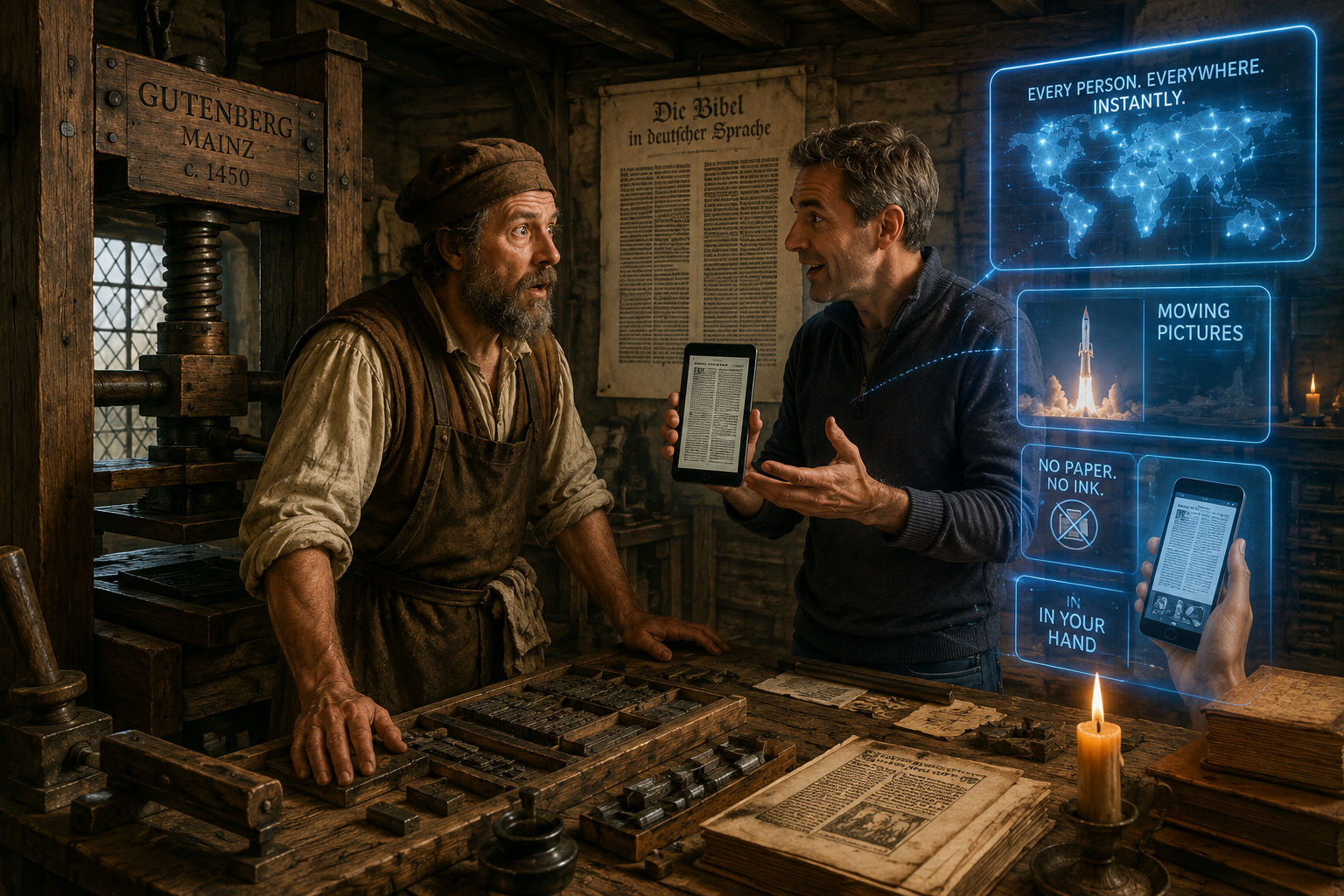
This weekend I went to my first Renaissance festival (thank you, Sharon). As I chatted with medieval blacksmiths and bards, my 21st-century mid-evil engineering brain started to wonder how to explain the 20th century technology revolution to a Gutenberg printing press operator living in 1500.
Me: Good morning, friend. Lovely press you’ve got there. Say — I just wanted to warn you: there’ll be some changes coming to your profession over the next 500 years.
Press Operator: 500 years, say’st thou? I scarce can keep mine apprentices sober for five days! But speak on—what manner of change approacheth?
Me: Big ones. Different fonts and beautiful typefaces. Color pictures.
Press Operator: Pictures! In color? Dost jest! Shall I hire an army of painters to daub each page by hand? We have but now escaped the drudgery of monkish scribes. With this press I can print a hundred copies of Genesis ere the next moon. We stand at the pinnacle of progress already! Why would any sane man invite such madness again?
Me: You won’t need painters. You’ll set pictures as you set type. And you'll make not hundreds, but deliver copies to every person on Earth in under a minute.
Press Operator: By Saint Luke’s left foot! A copy for each soul on Earth? That’s a forest of paper, sir! Shall we strip forests bare?
Me: Not at all. You won’t use paper. People will read it on screens.
Press Operator: Screens? What beast is that? Be it silk? Or sheep gut stretched thin?
Me: An electronic screen. You’ll hold it in your hand. It will show words and moving pictures. It will be powered by batteries.
Press Operator: Hold thy tongue! Thou wouldst have me clutch an artillery battery in my hand? What if it explodes? Moving pictures? Why should a picture move? The picture is either at the top of the paper or the bottom. If I desire motion, I’ll go to the tavern and watch a brawl!
Me: There's no paper. No ink. Just light and electrons.
Press Operator: No ink? Sir, I am a master of ink! Twenty years have I labored to perfect its flow. My black bleeds not, my letters bite crisp, my pages are prized across Mainz. Sire, I am a spelling master!
Me: Spelling? The machine will do that for you. You’ll need new skills — software, electronics, batteries. Don't get me started about lithium shipping!
Press Operator: I'm going to be soft where? What, like velvet gloves? And I am a master of lead.
Me: Oh fine sir, you’ll have to give up lead. It’s toxic.
Press Operator: Toxic? Four score and two Pah, lead is the lifeblood of civilization. When I’ve scrap type left o’er, the vintners grind it into their wines for sweetness. The bishop himself swears by it!
Me: Trust me, lead’s out, electrons and photons in. And you better be prepared to deal with growing tin whiskers.
Press Operator: Aye, and mayhap demons too! No ink, no paper, moving pictures, bottled lightning, and a beard of chain? — I like it not. I’ll keep my press, thank thee kindly.
Press Operator: Wait, what do you mean no paper?
<Fast forward five centuries>
Kodak Executive: Wait, what do you mean, no film?
I couldn’t explain to a Renaissance printer what it means to see videos on a screen and I can’t fully explain to myself what engineering will be like once AI takes hold.
I was trying to describe five hundred years of change to him… I’m trying to describe five years of change to myself.
My conversation with the Gutenberg press operator notes that a technology revolution doesn’t just change tools — it changes who participates, what skills matter, and what “competence” even means.
Engineering is not merely a discipline; it is a culture — a particular way of seeing the world and solving problems. Certain personality types have historically thrived in this environment. Over time, that culture evolves. I have personally witnessed changes such as the inclusion of women in engineering — from roughly 1% in 1970, to about 4% in 1981, to about 20% today. That shift alone reshaped teams, perspectives, and the work itself.
I asked ChatGPT to create a prompt for Sora to make a video of my fictional interaction with the Gutenberg press operator.It did an almost adequate job in less than one percent of the time it would have taken me. While I did not get a usable product, certainly it is a great way to make a first draft. If I had the patience to “argue” with it long enough, it would eventually make something I would consider acceptable.
This is the important part: interacting with AI as a creative engineering tool demands a different skill set from traditional engineering. It requires patience with ambiguity, tolerance for misfires, and a willingness to coax an unpredictable collaborator. Many traditional engineering minds are optimized for precision, linearity, and determinism — for a world where the slider labeled “error” can be driven toward zero with traditional engineering tools. By contrast, AI presents you with a slider labeled “narrative coherence,” another labeled “vibe,” another labeled “don’t give the press operator three microscopes,” and expects you to negotiate among them.
I know several people who thrive in this environment. They are not necessarily the same people who thrive under traditional engineering paradigm. They can do some things I can't do and I can do some things they can't. We are witnessing a shift in engineering practice and we are amidst a shift in engineering culture.
AI will open engineering to different personality types. I no longer need to be good at memorization, speed, and accuracy of the mundane. I need to be good at... we need to finish this sentence! This is not a minor footnote to be overlooked — it changes who becomes an engineer, how engineering teams function, how we will educate them, and what kinds of solutions emerge.
Every generation has feared that a new tool would destroy the skills of the old. In Plato’s Phaedrus, Socrates warned that writing would kill memory. Centuries later, critics said printing would ruin handwriting. The telegraph was accused of ending thoughtful letter writing, only to be “killed” in turn by the telephone, which some said encouraged idle chatter instead of precise communication. The typewriter was blamed for eroding penmanship, and then the computer wiped out the typewriter. The internet, we are told, has destroyed our ability to focus and read deeply. And now we fear that artificial intelligence will kill creativity itself. There is truth in these - handwriting has gotten worse. I did rely on spelling aids to write this. And AI will change things. But the trade-offs are overall good ones.
AI is scary. It is going to impact everything. Some jobs will be eliminated, some risks will be realized, and some fears will be justified. Be we will also realize a host of benefits.
At one time, only about 200 years ago, 98 percent of the population farmed. Today fewer than 2 percent farm, and yet a far smaller percentage of people starve. And we freed ourselves to do things other than farming. What looked like loss was actually transformation. Each so-called death marked an ending, accompanied by the birth of new forms of thinking, communicating, and creating. The problem is that the time frame is very short and we are doing without planning which is dangerous.
For this problem, we need people who plan the future, people who do actual manufacturing for a living, academics, industry leaders, people who are creating AI, and people who use AI working together to figure this out. In the strongest of terms, I recommend that we immediately study the question of what engineering is going to look like when we have fully developed AI engineering and at once transition our technical education including graduate school, undergraduate programs, trades programs, and K-12 STEM education.
We will do things that are unimaginable today. It's not just the AI that we need to develop, it's developing those who can use it effectively and responsibly. Like writing, the printing press, and the computer, whoever does this first and fastest is going to own everything.
This time, let's recognize this and plan the transition.
I propose a Solvay Conference like forum in Fall 2026. For more information, please see www.21stengineering.com. If you would like to participate, please contact the BUILD program at www.build4edu.com/contact.