
Preserving engineering in the age of AI
Engineering works — and it works remarkably well.
We have air conditioning.
We have GPS.
We have computers.
We have artificial heart valves.
We went to the Moon. We went to the Moon!
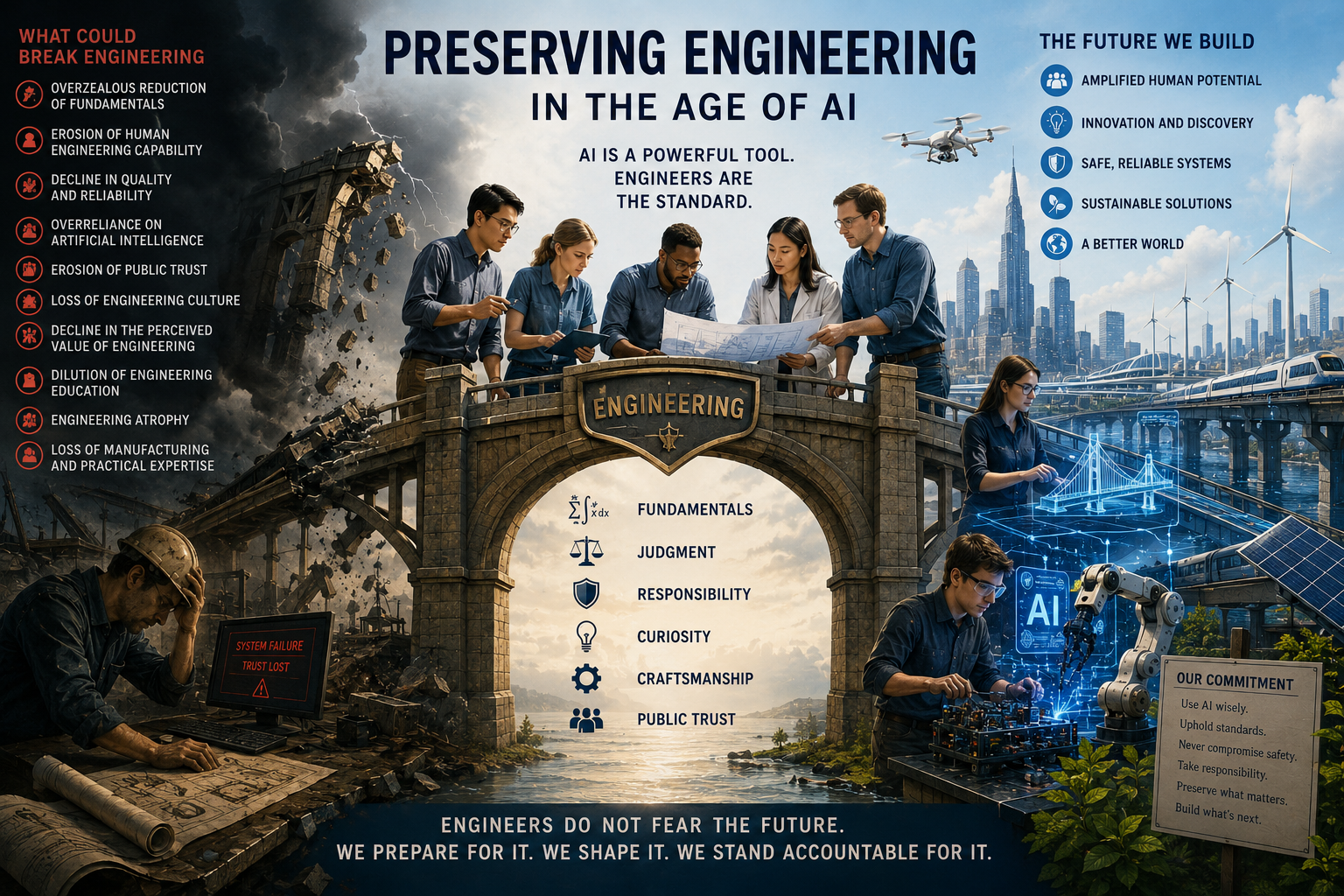
Engineers have improved the world in countless ways and earned something extremely valuable: public trust. Bridges generally do not fall down. Aircraft fly and land safely. Power grids function. Medical devices save lives. The environment that surrounds modern society is the result of generations of engineers applying science with enthusiasm, rigor, judgment, and responsibility.
As AI takes on more and more engineering tasks, we must pay very close attention that we do not degrade public perception of what we do and how it impacts society.
We are discussing major reforms to engineering education and engineering practice, largely driven by the rapid emergence of artificial intelligence. The capabilities of AI are changing the tools engineers use and the workflows through which engineering is practiced. How do we ensure we don’t break engineering?
Engineering is not merely a set of classes we took, techniques, and software tools. It’s not just a group of nerds programming RTOS’s to blink LEDs on robot vacuum cleaners. It is a body of knowledge, a system of responsibility that has developed over several centuries, and a professional culture.
What Could Break Engineering?
Several risks deserve careful consideration as the profession adapts to a new technological era.
Overzealous Reduction of Fundamentals
In the unavoidable effort to modernize curricula, institutions will reduce instruction in math, physics, and other engineering foundations. We have no choice – we must make room for new curricula. These subjects are not academic formalities; they are the
intellectual framework that allows engineers to understand, question, optimize, and guarantee the reliability and trustworthiness of the systems we design. Overzealous reduction in teaching engineering fundamentals such as math and science could be the death of what we have created if we do it wrong.
Erosion of Human Engineering Capability
Excessive reliance on automated tools and artificial intelligence will erode human skills to design, maintain, and improve complex systems. Over time this could lead to:
Slowing or halting advancement of technology
Difficulty maintaining existing technology infrastructure and capabilities
Increased safety risks
Reduced ability to apply new scientific discoveries
Loss of deep technical understanding
Decline in Quality and Reliability of Everything It is engineers who provide the promise of quality and reliability. Engineering success depends on rigorous standards, careful analysis, and professional judgment. If these weaken, the quality and reliability of the systems upon which society depends will deteriorate. Airplanes, medical equipment, cars. In 1988, our pager infrastructure was crippled for three days by a tin whisker. What would the impact be if our cell phones stopped working for three days?
Overreliance on Artificial Intelligence
AI will become an extraordinarily powerful engineering tool, but tools must remain subordinate to human judgment. We must be careful to let computers do what they do well and maintain the ability of human engineers to do what they do better. Engineers must retain the ability to verify, question, and override automated outputs.
Erosion of Public Trust
Engineering has earned public trust through decades of reliability and professionalism. It is not difficult to recall high-profile failures that quickly lost public trust in technology.
An increase of frequency, intensity, and impact of such failures is inevitable as we increase the use of automated systems. Unchecked, this will damage public trust in ways that are difficult to repair.
Loss of Engineering Culture
Engineering is culture built on curiosity, craftsmanship, problem solving, and pride in building systems that work. This culture is about to go through its biggest change in its history.
Decline in the Perceived Value of Engineering
If society begins to view engineering as something performed primarily by machines rather than by highly trained professionals, the field may become less attractive to the next generation of talented students.
Dilution of Engineering Education
It has been a wonderful thing that calculators and computers have taken over mundane calculation of arithmetic operations. It is a wonderful thing that AI will take over the rigor of mundane calculation and design, and we will be tempted to make engineering education simpler given AI assisted design. If engineering programs become unacceptably less demanding or less technically rigorous, the profession itself will weaken.
Engineering Atrophy
Skills that are not exercised eventually disappear. If engineers cease performing core analytical and design tasks themselves, those capabilities will vanish. That may be acceptable and even advantageous freeing us up to do higher level things, but we must ensure we do not lose our understanding and abilities.
Loss of Manufacturing and Practical Expertise
Engineering does not exist solely in theory. It lives in laboratories, factories, and machine shops. Loss of practical knowledge about how things are built will significantly weaken technological capability.
Preserving Engineering in the Age of AI
The goal is not to resist change. Artificial intelligence will undoubtedly become one of the most powerful tools engineers have ever used. Properly applied, it will accelerate discovery, improve design exploration, and expand what engineers can accomplish.
But the success of AI in engineering will ultimately depend on the continued existence of engineers who eagerly understand the underlying science, love, live, and thrive on application, who embrace moving technology but recognize when automated systems are wrong, and who accept responsibility for the systems they create.
AI assistance in designing a bridge, diagnosing a medical device, or optimizing a power grid are going to make wonderful improvements to our innovations. But when those systems fail — lives depend on whether they will fail—society will still look to engineers, not algorithms, for accountability and judgment.
For that reason, the central challenge facing engineering in the coming decades is not simply how to incorporate artificial intelligence into engineering practice. It is how to ensure that even as the tools evolve, the human capability that made engineering successful in the first place is preserved.
The future of engineering should therefore be defined not by replacing engineers with intelligent machines, but by ensuring that the next generation of engineers is capable of using those machines effectively, responsibly, and wisely.